
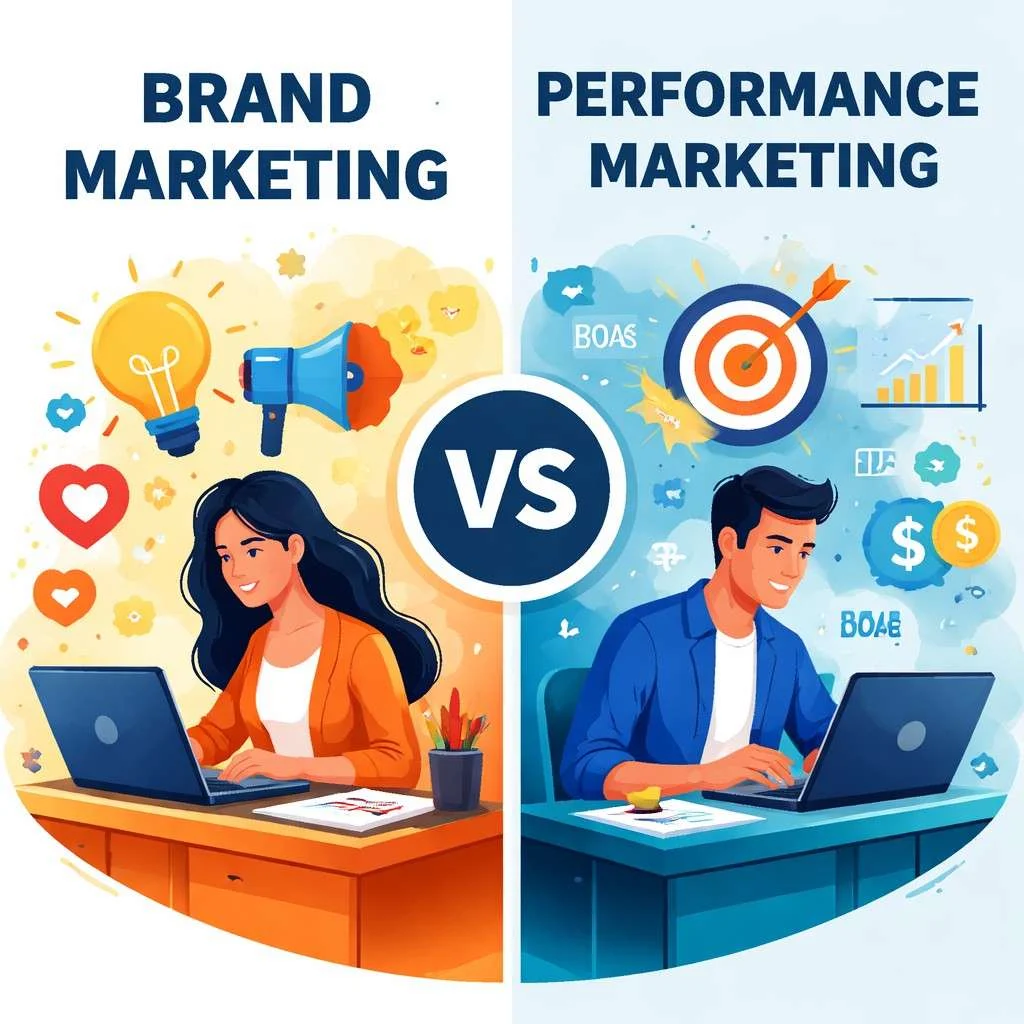
Understanding Brand Marketing vs Performance Marketing in the Indian Context
Introduction: The Illusion of Growth in Indian Marketing
Indian brands today can reach more people than ever before. A few clicks can push ads to millions. Sales can spike within hours. Dashboards fill up with ROAS, conversions, and lead costs. Everything looks efficient and under control. Yet beneath this surface level success, something feels broken. Growth is happening.
But something is off.
Many brands are growing faster than ever, yet becoming weaker underneath. Customer loyalty is low. Acquisition costs keep rising. Discounts feel permanent. The moment ad budgets slow down, revenue collapses. This is not accidental. It is the result of over dependence on performance marketing and a poor understanding of brand marketing vs Performance marketing.
Performance marketing is powerful. But when it becomes the only growth strategy, it makes brands dangerously short sighted.
This article breaks down brand marketing vs performance marketing, why Indian brands are becoming short sighted and how the smartest ones are fixing it.
Why Performance Marketing Became the Default in India
Performance marketing fits perfectly into the modern Indian business environment. It is fast. It is measurable. It looks logical in board meetings. Founders like it because results are visible. Investors like it because numbers move quickly.
There are clear reasons it dominates today:
- Digital platforms made advertising accessible to everyone
- Startups needed quick proof of traction
- Dashboards simplified decision-making
- Short-term results were rewarded more than long-term thinking
But ease is not the same as effectiveness. Performance marketing answers one question very well: Did this ad lead to a conversion?
It does not answer the more important one: Why did the customer choose you at all?
That unanswered question sits at the heart of the brand marketing vs performance marketing debate.
What Performance Marketing Is Actually Designed to Do
Performance marketing is not broken. It is simply misunderstood.
Its real job is demand capture. It works when customers already have intent. They are searching, comparing, or ready to act. In those moments, performance marketing shines. It reduces friction and speeds up decisions.
It is extremely effective for:
- Short buying cycles
- Price driven categories
- Familiar products and services
- Utility based decisions
The problem starts when brands expect performance marketing to create preference, loyalty, or emotional connection. It was never built for that. When teams try to force performance marketing into a role meant for brand building, growth becomes unstable.
Understanding this boundary is essential to grasp brand marketing vs performance marketing properly.
How Performance Marketing Quietly Changes Brand Behaviour
Over time, performance marketing reshapes how brands think and behave. Creative decisions become data-led but not insight led. Messaging narrows to what converts fastest, not what differentiates best.
Slowly, certain patterns appear:
- Brands sound more alike
- Offers replace stories
- Discounts replace meaning
- Short-term wins replace long-term equity
Customers respond accordingly. They become transactional. They chase offers. They switch brands easily. Loyalty reduces not because customers aren’t loyal, but because brands stopped giving them a reason to care.
This is how performance marketing turns from a growth tool into a dependency.
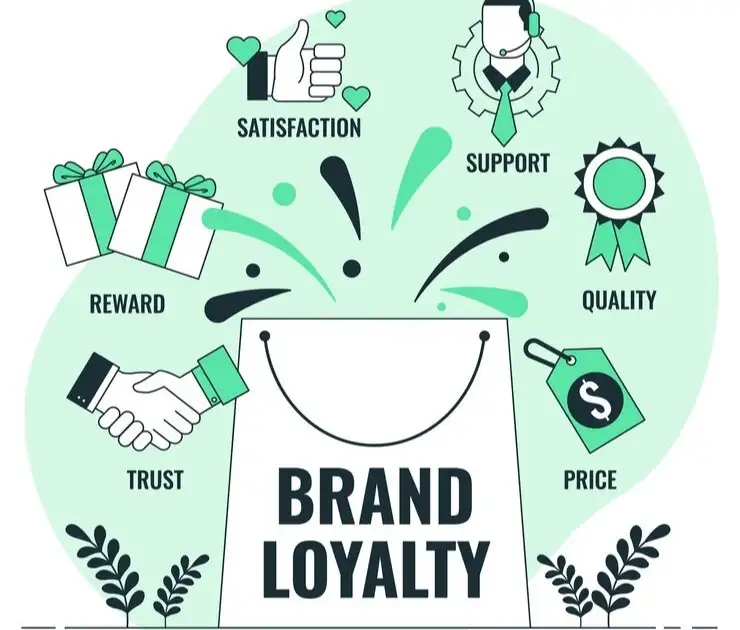
What Brand Marketing Does That Performance Marketing Never Can
When it comes to brand marketing vs performance marketing .We get to know brand marketing works before demand exists. It shapes memory, perception and emotion long before a purchase decision is made. It answers questions customers may forget to ask.
Brand marketing builds:
- Familiarity, so the brand feels known
- Trust, so choice feels safe
- Meaning, so the brand stands for something
- Memory, so recall happens naturally
When brand marketing is strong, performance marketing becomes cheaper and more effective. Click through rates improve. Conversion rates rise. Customers return without incentives. In the long run, brand marketing reduces risk.
This is why brand marketing vs performance marketing is not a rivalry. It is a relationship. One creates demand. The other converts it.
Why Indian Brands Struggle In Brand Marketing
Despite knowing its importance, many Indian brands are avoiding the need to invest in brand marketing. The reasons are practical, not ideological.
- Brand impact is harder to measure
- Results take time to appear
- Dashboards do not capture memory or trust
- Short term pressure dominates decision making
In fast moving markets, patience feels risky. But ignoring brand is riskier. Brands that delay brand building often find themselves trapped later, spending more money just to maintain the same level of growth.
The irony is clear. What feels like a safe choice today becomes the most expensive mistake tomorrow. This is the hidden danger in misunderstanding brand marketing vs Performance marketing.
The Attribution Problem That Distorts Reality
One of the biggest reasons performance marketing appears superior is attribution. Most companies rely on last-click models. This gives credit to the final interaction and ignores everything that came before it.
In reality, customers are influenced by many touchpoints:
- Content they consumed weeks earlier
- Creators they trust
- Offline conversations
- Previous brand experiences
Brand marketing plays a major role in these early influences. But because it is hard to track, it often gets undervalued. Budgets shift away from brands toward channels that “show results”.
This is not a marketing failure. It is a measurement limitation. In the brand marketing vs Performance marketing discussion, attribution bias consistently makes performance look stronger than it really is.
The D2C Boom and the Cost of Short Term Thinking
India’s D2C boom offers a clear lesson. Many brands scaled rapidly using paid ads. Early success felt effortless. CAC was low. Growth charts looked impressive.
As competition increased, reality hit:
- CAC rose sharply
- Discounts became unavoidable
- Margins shrank
- Retention weakened
Brands that relied only on performance marketing struggled to sustain growth. Those that invested early in brand building saw a different outcome. Nykaa is a strong example. It focused on education, trust, and community. Performance marketing worked better because the brand already existed in consumers’ minds.
This contrast shows exactly why ignoring brand marketing vs performance marketing balance is costly.
Zomato and the Power of Brand Memory
Zomato did not win because it had the best coupons. It won because it built a brand people remembered and liked. Its tone, humour, and cultural relevance created emotional familiarity.
Even when competitors offered similar deals, users preferred Zomato. Smaller apps that relied mainly on performance ads struggled once discounts reduced.
This difference highlights a simple truth. Performance marketing captures attention. Brand marketing captures memory. Memory lasts longer.
When Performance Marketing Truly Makes Sense
Performance marketing works best when demand already exists and the decision is simple. Categories with low emotional involvement benefit greatly from it.
Examples include:
- Local services
- Education lead generation
- Insurance aggregators
- Utility apps
Even in these cases, brand marketing improves efficiency. Trust reduces friction. Familiarity increases repeat usage. Performance marketing works best when supported by a brand, not when replacing it.
Where Performance Only Strategies Fail Badly
Some businesses cannot afford to ignore brand marketing. Premium products, new categories, long consideration purchases, and B2B services require trust before action.
Without brand building:
- Ads attract price sensitive users
- Lead quality drops
- Sales cycles lengthen
- Margins erode
In these cases, performance only thinking damages the business. A strong understanding of brand marketing vs Performance marketing is not optional here. It is essential for survival.

The Real Cost of Short Sighted Growth
Brands that over rely on performance marketing eventually face the same problems:
Rising acquisition costs
Permanent discounting
Weak loyalty
Loss of pricing power
Growth becomes fragile. Revenue depends entirely on spend. The moment budgets pause, demand disappears. Brand marketing solves this by creating demand that exists independently of ads.
This is the long-term economic advantage most dashboards fail to show.
Rethinking Brand Marketing vs Performance Marketing
The smartest brands stop asking which one is better. They ask how each should be used.
Brand marketing creates future demand
Performance marketing converts existing demand
Brand defines direction
Performance executes speed
When these roles are clear, growth becomes sustainable. When they are confused, growth becomes expensive.
Final Thoughts: Why the Next Decade Will Reward Brands, Not Ads!
- Performance marketing will continue to be important. It is not going away. But brands that rely on it alone will struggle as competition increases and attention becomes scarcer.
- Indian brands that win the next decade will invest in memory before chasing intent. They will understand brand marketing vs Performance marketing not as a choice, but as a balance.
- If you want lower CAC, stronger loyalty, and real pricing power, ask yourself one honest question:
Would customers still choose us if ads disappeared tomorrow?
The answer to that question determines whether you are building fast growth or a lasting brand. And this makes the difference between brand marketing vs performance marketing.
Author

Anjana Das is a digital marketing strategist based in Kochi, India.
She works with early stage brands and personal brands, focusing on content, social media, performance marketing, and SEO. Her approach is grounded in real execution, learning through doing, and building long-term trust rather than chasing short term tactics.